

Welcome back to Antlers Lodge. Feel free to click play on the field recording above while you read; thanks for being here!
There’s a moment just before dusk, when everything holds its breath, then all at once, lets go.
I’ve been coming to Melbourne for a few years now to visit my girlfriend. As I acclimate to the way things are down under, I’m starting to feel less like a tourist with each visit. But I still remind myself every day to look both ways when crossing the street.
Melbourne is a melting pot of cultures, often referred to as the city of a hundred cities. It has plenty going for it: unique neighborhoods, great food, endless parks to stroll through, a thriving music & arts scene, and, oh yeah… the coffee!
But like any city, it can be overstimulating. I try to get away when that feeling takes over. Any good doctor would prescribe getting some fresh air and sunshine on the pupils when this happens. It’s not hard to find a place down here where the roads turn to dirt and your nearest neighbor might be a kangaroo.
This trip brought us out into goldfield country, about 90 minutes northwest of Melbourne, to the small town of Castlemaine. It’s a place that wears its history well, with wide nineteenth-century streetscapes, manicured rows of autumn-colored trees, stone buildings, and a theater that has been running since 1854. What the postcards don’t show you is that this place was occupied long before the gold rush turned it inside out.
The Dja Dja Wurrung people (the Jaara) had lived on this land for thousands of years. They knew the creeks and woodland ridges intimately, used volcanic stone, and hunted across vast territories. Then, in July 1851, gold was discovered, and within a year somewhere between forty and sixty thousand people had descended on Castlemaine. The creeks the Jaara had relied on for water were dug up. Sacred sites were buried under industrial waste. It was a catastrophe dressed up as fortune.
Forests do remain; as the Box-Ironbark woodlands that roll across the hills around town are still recovering. They are extraordinary. Over 215 bird species have been recorded in the Castlemaine region alone. The endangered Regent Honeyeater clings to these trees. So do Diamond Firetails, Turquoise Parrots, Bush Stone-curlews, Hooded Robins. The same habitat the gold rush degraded is now one of the most biodiverse woodland ecosystems in southern Australia.
I didn’t know most of this when I set up my recorder that evening.
On our last night at the cabin, I did what I always do. I pulled out my handheld recorder and a pair of LOM microphones and hiked around the cabin to find a good listening spot. I found a satellite antenna near some bird activity, attached my mics to the metal pole with magnetic clips, then hit record and went back to the porch to listen.
What I heard was this: the birds chattering as they debrief the day's activity. Wind moving through the ironbarks. A nearby neighbor practicing the piano before dinner. Then, midway through the recording, a mob of kangaroos came hopping down the hill. You can hear them unbothered as they pass close enough to the microphones. Then they’re gone, and the birds and the wind take the sound back, and eventually even those fall quiet. I’m glad I didn't leave the mics on the ground, as they would have been trampled on.
I found myself returning to this recording more than I expected to. There’s something in the wind that holds the truth. Yet some still remains buried beneath the layers. Some places ask to be listened to. This is one of them.
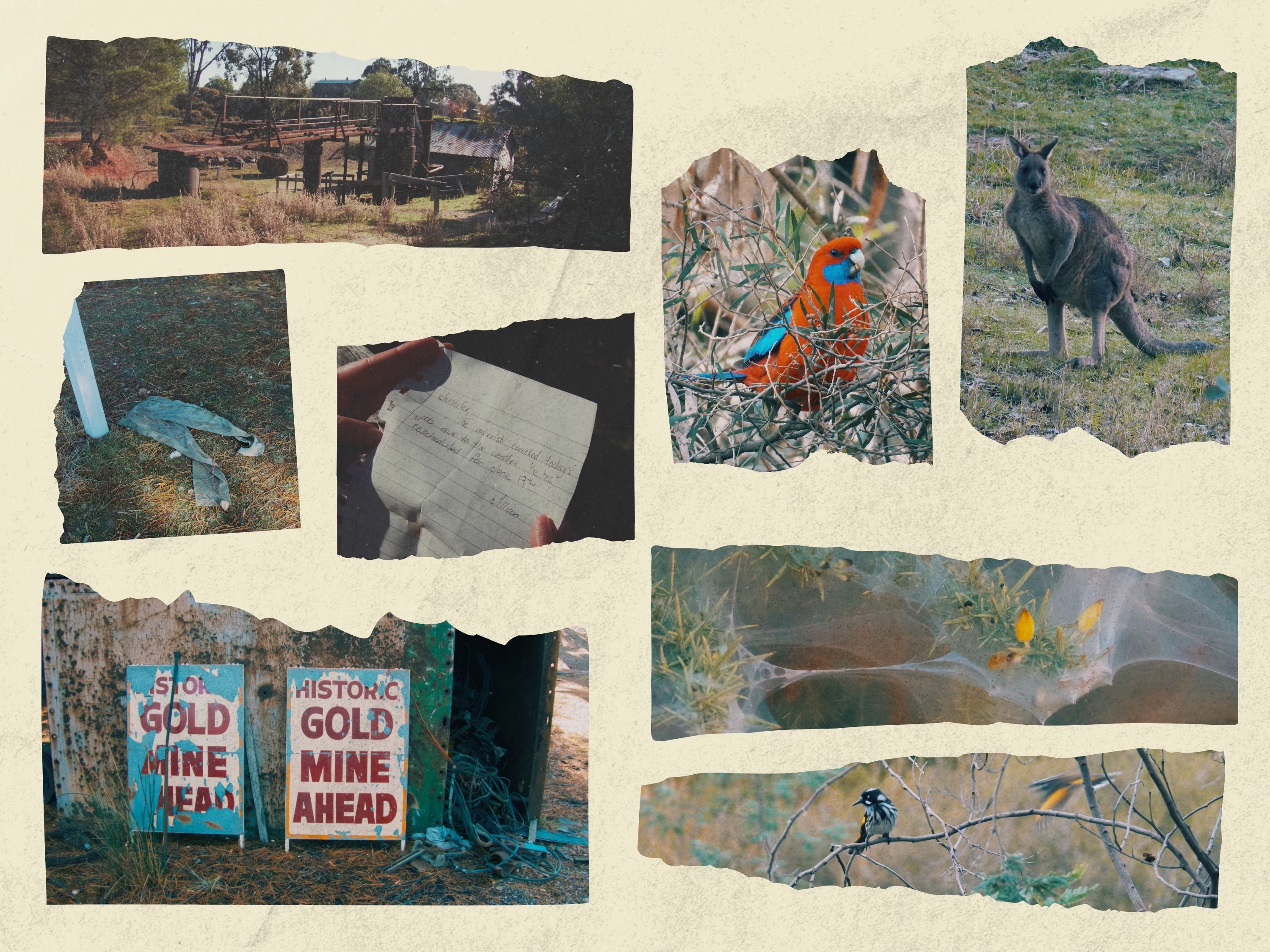
Field Notes: If you’re looking for tranquility, I recommend renting a cabin and staying somewhere outside of town.
We came in around dinner time and stopped over to Love Shack Brewing Co. for one of the best burgers I’ve had yet down under. It’s right next door to the Theatre Royal, so if you find yourself in town for some live music or a film screening, pop over next door afterward for a pint and a smash burger.
We spent the morning at the cabin reading our books, watching the sunrise over the tree canopy, and drinking a few cups of tea before going sightseeing in bush country.
First up was the Mill for some antique shopping. There’s a piano in the main lobby when you first enter, which sounds very nice if you’re inclined to play the opening theme to Twin Peaks, as I was. I managed to talk myself out of buying an overpriced, Japanese-made classical guitar that needed restoration. Great spot if you want to kill several hours for nostalgia.
After the Mill, we went out for a walk at the historic site of Forest Creek Gold Diggings. It took about an hour to stroll through everything, reading some problematic, yet intriguing industrial history along the way.
Before heading out of town, we managed to get a hike in along the Campbell Creek Trail. The neat thing about this area is that you can walk anywhere. There are trails connecting the towns, and everything is connected. Great for biking if you have one. We managed to get some birdwatching in on the walk to Five Flags Merchants before breakfast.
Before heading back to Melbourne, I stumbled across a record while browsing in the store that caught my eye. I was first intrigued by the cover art, as it looked hand-drawn and captured the area we were visiting quite well. The album was Goldfeels by Dan Kelly and is a fun listen if you're in the mood for jangly indie power pop. Oddly enough, he was in the store getting some food when I picked it up.
There seems to be a lot of great music and art pouring into the area from Melbourne. Not a bad place to be for a guitar-obsessed birdwatcher with a field recorder in his back pocket.
Do you ever visit a place and say to yourself, "I could live here"?
Well, this is one of those places.
If a paid subscription isn’t for you but you still want to show your support, you can…


